Understanding Nolan's The Odyssey

From Troy
to Ithaca

In the night, Troy opens its gates.
A wooden horse hides victory.
Odysseus thinks the return is within reach.
Already, the sea is preparing its revenge.

Official trailer

Watch the trailerbefore the journey

The site keeps Homer and the myth as its base, while the trailer gives the first visual rhythm of Christopher Nolan's film.

The film

Nolan enters Homer's long shadow.

Universal presents The Odyssey as a large-scale mythic epic, shot around the world and opening in theaters on July 17, 2026. At this stage, one question dominates: how will Nolan hold together the ashes of Troy, the anger of the sea and this man, Odysseus, who won the war without finding his way home?

Checked on April 28, 2026

Confirmed so far

  • Christopher Nolan writes, directs and produces the film with Emma Thomas for Syncopy.
  • Universal officially lists Matt Damon, Tom Holland, Anne Hathaway, Robert Pattinson, Lupita Nyong'o, Zendaya and Charlize Theron in the main cast.
  • The film is described as using new IMAX technology and as being made for IMAX screens.

Still to watch

  • Full role assignments: several character names have been reported, but not every role is listed on the official site yet.
  • Precise filming locations: reports point to several countries and Mediterranean settings, to be confirmed as promotion continues.
  • How much of the film stays in Troy: early presentation descriptions mention a large-scale opening around the horse.

IMAX

Why IMAX matters here

This is not only a matter of format. The Odyssey is a story of seas, thresholds and small human figures facing landscapes larger than themselves. If the IMAX promise holds, the format can tell exile as much as dialogue: distance, fear, and then the obsession with return.

Announced cast

Matt DamonTom HollandAnne HathawayRobert PattinsonLupita Nyong'oZendayaCharlize Theron

Fast route

Fifteen minutes to enter The Odyssey.

Troy, Odysseus, Poseidon, the sea episodes, Ithaca: the solid minimum before the theater, without turning the myth into homework.

Before the screening

A short thread for understanding what the film may condense and what should remain visible.

Two modes

Enter the myth before. Judge the film after.

The journey accepts mythological spoilers, but keeps a clear line between what Homer and the Trojan cycle say, and what the film will actually show after release.

Mythological spoilers are explicit: Homer, Troy, Odysseus, the gods and the end of the return. No film speculation is presented as certainty.

Odysseus' route

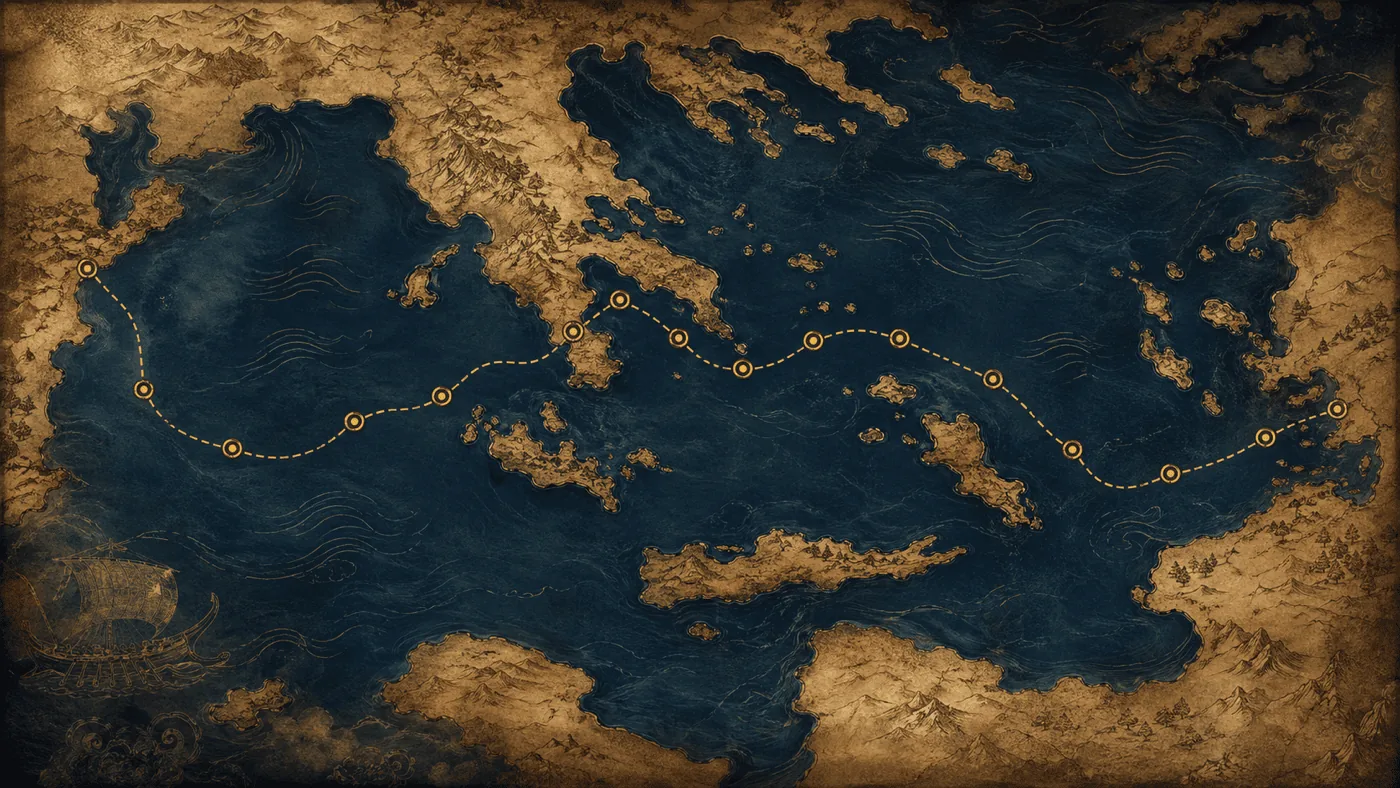
One boat, fourteen episodes, one question: will he get home?

Sequence of episodes

4/14 · CyclopsBack to the map

Episodes

At every shore, the return slips away.

In the myth

A cursed city, visible gods, an impossible journey.

Troy burns because human cunning forced the gates open. The sea then becomes the domain of Poseidon, monsters, nymphs and thresholds where Odysseus risks forgetting his name, his crew and his return.

In the real world

Hisarlik, the Dardanelles, excavations, museums.

The archaeological site of Troy is linked to the mound of Hisarlik, near the southern entrance to the Dardanelles. It is the perfect anchor for separating myth, memory and material history.

Bestiary

Medusa, Sirens, Cyclops.

A section for reading mythological creatures by what they do to the hero: frighten, tempt, guard a threshold, or force intelligence to change its method.

Bestiary

A clear index of the great Greek creatures, from The Odyssey to the labors of Heracles.

Sources

Homer, archaeology, cinema.

Nolan's film opens a door, but the foundation remains older and firmer: ancient text, Trojan context, museum objects and the real world.

Reading depth

What this page adds

This home page works as a map rather than a poster. The film is the doorway, but the real subject is the route from Troy to Ithaca, the cost of cunning, and the slow passage from victory to return through memory, recognition, tested loyalty, political repair and justice.

The editorial promise is simple: read quickly if you need orientation before the screening, then move deeper through episodes, gods, creatures, places and sources. Every short door leads to a developed page rather than to a decorative summary.

The rhythm is deliberate: immediate entry points first, then a more patient invitation to understand why the myth remains dramatic before it becomes spectacular.